It started as a whiteboard, and then a flower appeared
What began as a simple whiteboard on a door has grown into a daily ritual of creativity, connection, and joy for patients at Rady Children’s Hospital at Mission (Rady Children’s), a reminder that healing isn’t only about treatment, but also about moments that make kids feel like kids again.
Nurse manager Darren Reilly first put the whiteboard up for a practical reason: to let his team know when he was in a meeting. It was nothing more than a communication tool until one day, a flower appeared.
When creativity caught on
Patients in the hospital’s eating disorders program often stay between three and six weeks. Once they reach “level two” in their recovery, they’re cleared to walk three laps around the unit each day.
During one of those laps, a teen stopped, picked up the marker, and drew a flower.
From there, the drawings kept coming.
“One flower led to more,” Darren says, “which led to a few characters, and then it took over.”
The small 8×11 board filled up quickly. That’s when Darren brought in a larger one, giving patients more space to create.
Prompts that spark connection
To keep the creativity flowing, Darren began adding drawing prompts:
“Draw a hot air balloon.”
“Draw a squirrel with a hat.”
“Draw a rainbow.”
These prompts change every day. And because the kids do laps every day, the whiteboard became something consistent and fun to look forward to.
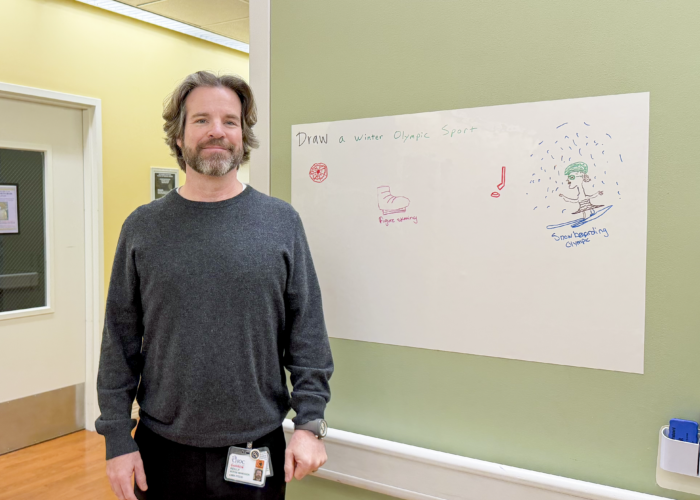
Mental health and clinical assistants often walk alongside the patients, and many stop to draw with them.
“Let’s do it together,” they’ll say.
When Darren is off, the mental health assistants or clinical assistants continue the tradition by switching out the prompt.
Kids respond in all kinds of ways—some excited, some hesitant.
“Some kids might feel insecure that they don’t draw well,” Darren says. “Seeing staff have fun with it and express themselves helps the kids open up too.”
A moment of joy in the middle of treatment
What started as a simple board has grown into something meaningful for patients and their families. “Parents tell me how much it means to their kids,” Darren says. “For a teenager in the hospital for three weeks—away from friends, with no routine, not in control—this becomes something they look forward to.”
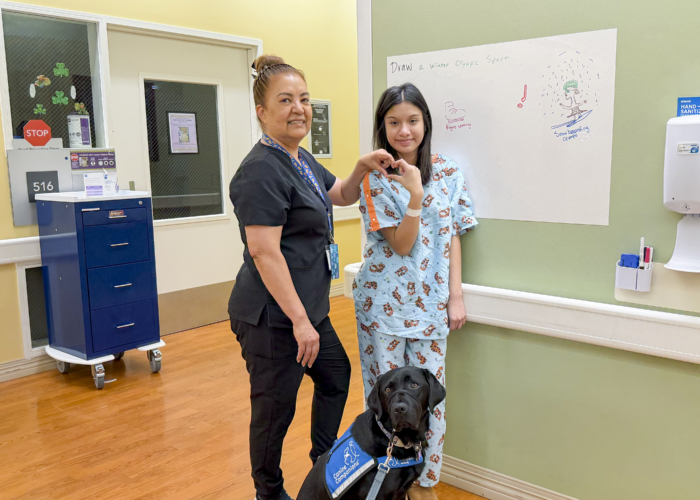
It’s not just about creating their own drawings; it’s also about seeing what other kids added that day.
“It allows them to be silly and be kids,” he says. It builds community when they talk about it. The drawings do a lot of things inadvertently.”
Even kids who aren’t part of the eating disorder program stop to add their own artwork.
“It’s such a silly thing that I had no idea would have such an impact,” Darren says. “But kids look forward to it every day.”
The power of being genuine
There was no research plan behind this. No committee. No formal program.
Just a genuine moment that kept growing.
Darren talks to his nurses often about the value of authenticity.
“If you’re genuine and just yourself, it opens the door for our patients to open up,” he says. “It’s very freeing. There’s no pressure—it’s just: be a kid, be silly, have fun with it.”
Why small acts matter
The whiteboard has become a daily reminder for Darren of something bigger: the importance of kindness. “Do it because you want to make that kid’s day,” he says. “Treat people the way you should treat them, and everything will work its way out.”
What began as a single flower has become a cherished part of patients’ days, a space where healing happens through creativity, connection, and compassion.